Action · Drama · History
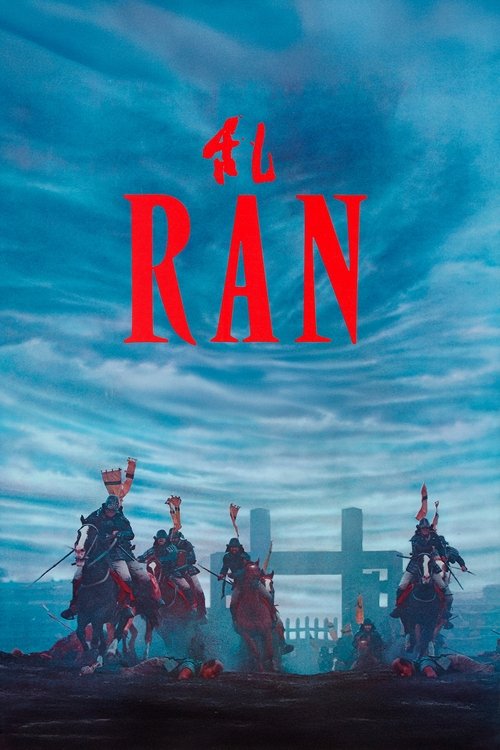
Ran
Japanese (乱)
1985 · Directed by Akira Kurosawa · 160 min


Action · Drama · History
Japanese (乱)
1985 · Directed by Akira Kurosawa · 160 min






Meaning, unpacked
Central idea
The film can be read as an inquiry into how power built on violence ends up consuming itself and its family. Kurosawa suggests that no ruler can retire from the consequences of his past, and he views human cruelty from a bleak, almost cosmic distance.
What it means
Ran asks a hard question: can a man who built his power on violence ever step away from it? Kurosawa's answer is no. Hidetora, an aging warlord, divides his lands among his sons and gives up his throne, but he cannot give up what he did to win it. No ruler can retire from the consequences of his past, and his house destroys itself.
The film's themes grow from that idea. Violence returns to its source: Hidetora rose by destroying others, and Lady Kaede, whose family he destroyed, turns her hatred into a plan. The film treats her revenge as both understandable and corrosive. Handing over power proves impossible to do cleanly, because sons, spouses and old retainers all see the abdication as an opening. Pleasing words are rewarded and honest ones punished, so Hidetora cannot see that Saburo and Tango, with their unwelcome truths, are the loyal ones. And when characters protest at the heavens, Kyoami replies that the gods may be cruel, or may simply not care. The film never settles it.
Why it mattered
Ran arrived in 1985, when Kurosawa was in his mid-seventies, and showed that a large-scale historical epic could still be made as serious, personal art. It was a prestige event, and it scaled up his samurai films and his Shakespearean work to the biggest budget a Japanese film had had at that point.
It also changed what an epic could look like. The attack on the Third Castle is the film's centre: Kurosawa removes the sound of battle and leaves only Takemitsu's music, so slaughter becomes a grieving, almost operatic tableau. Emi Wada's costumes gave the sons' forces yellow, red and blue, turning colour into a language that makes complex battles easy to follow. Telephoto lenses flattened space so ranks of soldiers look like figures on a scroll painting. And rather than simply filming King Lear in Japanese, Kurosawa rebuilt it from the legend of the warlord Mori Motonari and his three sons, drawing on Noh theatre, so it feels like a native Japanese story.
Before anyone tells you what to think: what did you make of it?
Log in to rate it and leave commentsIt takes one click with Google or an email link. You come straight back here.
Rate it, keep your notes, and find the next film.
Free, no ads. Your journal, your lists, a Cine Guide that remembers you.
Create your free spaceRan's colour-coded armies, tableau-like compositions and large-scale practical battles became a reference point for later historical epics, especially in East Asian cinema. It is taught alongside King Lear as a model of cross-cultural adaptation, and for many Western viewers it is a first look at Noh. Some commentators also read it as a reflection on Cold War and nuclear anxieties. It won one Oscar, for Wada's costumes, from four nominations.
It premiered at the Tokyo International Film Festival in 1985 to strong reviews, especially abroad. Critics praised its visual ambition and Tatsuya Nakadai's performance, though some found its pessimism and slow pace severe. Today it ranks among Kurosawa's finest works and among the great Shakespeare adaptations, and restorations have let viewers see its colour design properly. Some still prefer the energy of Seven Samurai, a good place to go next. Few dispute Ran's grandeur.
What happens
Saburo is shot dead and Hidetora dies holding his body. Jiro's domain falls to enemy attack and Kaede is killed. The whole house is gone, and the revenge and ambition that destroyed it leave nothing behind.
The last image
The blind Tsurumaru, left alone among the ruins, stands at the edge of a wall, with a scroll of the Buddha dropped beside him.
Two readings
What it says
Hidetora cannot escape what he did to win his power, so his house collapses with him. Kurosawa leaves a helpless survivor at the edge of a drop to show that violence offers no comfort and the heavens give no answer.
Or follow an idea from this film

Continue the director
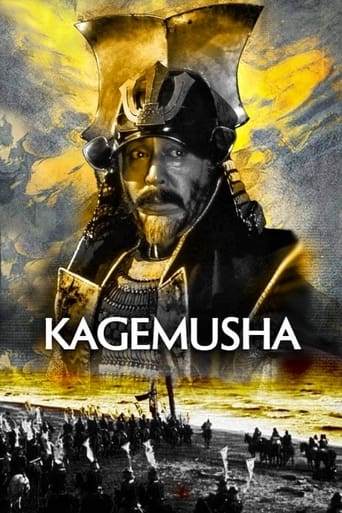
Kagemusha (1980)
Kurosawa's preceding historical epic is the natural companion, showing the same sixteenth-century world, the same ambition and an earlier version of his late style.
Follow the idea
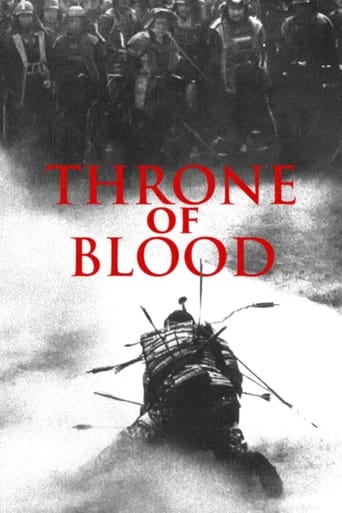
Throne of Blood (1957)
Kurosawa's Macbeth shows the Shakespeare-through-Noh approach in its leaner, earlier form, and makes a good comparison of the two adaptations.

Explore the era or movement
Seven Samurai (1954)
Kurosawa's earlier samurai epic is more humane and energetic, so it shows what his later pessimism grew out of.
Compare another approach
Harakiri (1962)
Masaki Kobayashi's samurai drama is another severe critique of feudal loyalty and violence, formal and tragic in a way that complements Ran.
Compare another approach
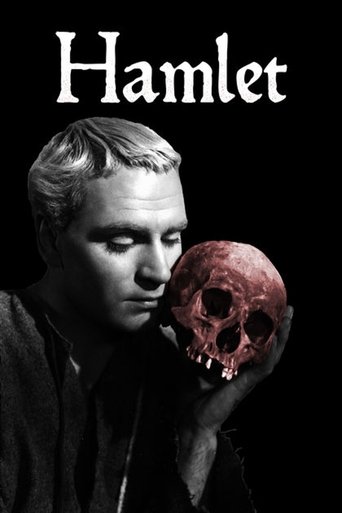
Hamlet (1948)
Laurence Olivier's Shakespeare adaptation provides a useful contrast: a stage-based English approach versus Kurosawa's wholesale cultural reimagining.