

Drama
Tokyo Story
Avg rating 9.1 / My rating TBC
1953 · Directed by Yasujirō Ozu · With Chishū Ryū, Chieko Higashiyama, Setsuko Hara
- Japanese Golden Age
- Art Cinema
- Melodrama
An elderly couple leave their small town in western Japan to visit their grown children in postwar Tokyo. Ozu watches this ordinary trip with stillness and gentle humour, asking what family members owe one another as life speeds up.
Film info
- Runtime
- 2h 17m · 137 min
- Format
- Black and white, 4:3 Academy ratio, Japanese language. Always watch with subtitles, since much of the meaning is in phrasing and politeness.
- IMDb
- 8.1 / 10 (76,665 votes)
- Rotten Tomatoes
- 100% (critics)
- Metacritic
- 100 / 100
- TMDB
- 8.1 / 10 (audience, 1,268 votes)
- Trailer
- ▶ Watch the trailer

Before watching
Spoiler-free · about 2 minutes
Short on time? Spoiler-free
A 3-minute summary
Why watch this?
The summit of Yasujirō Ozu's art
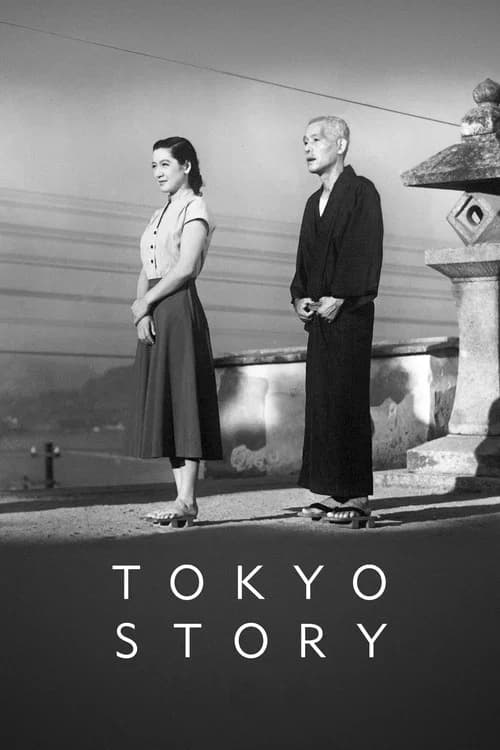
Ozu's best-known film, and the work most often used to define his mature style: low fixed camera, quiet domestic drama and the shomin-geki tradition of ordinary-family stories. Many viewers treat it as the entry point to Japanese cinema.
A new way of telling a story
There are almost no camera movements, no big plot events and no music swells. The film builds its emotion through placement, pauses and small gestures, which teaches you to watch differently.
A family story that translates anywhere
Though rooted in 1950s Japan, its questions about parents, children, time and obligation are recognisable almost anywhere. It is among the most humane films of the era.
Why it matters in cinema history
A defining work of the Japanese golden age and of the shomin-geki family drama, it carried Ozu's distinctive minimalism to an international audience and became a reference point for quiet, observational cinema.
Watch with intention
Your lens
Watch it as a film about attention: how people look at one another, and how the camera patiently looks at them.
Three things to notice
- The camera sits low, near the height of someone seated on a tatami mat, and rarely moves. Notice how this changes the way rooms and conversations feel.
- Brief shots of empty rooms, corridors, laundry, chimneys and rails appear between scenes. Notice what they do to the rhythm and what they let you feel.
- Characters often speak politely and cheerfully while saying something else. Listen for the gap between what is said and what is meant.
One question to carry with you
Who in this film has time for whom, and what does each character's idea of time reveal about them?
- Industry
- Japanese cinema was thriving in the early 1950s. Studios such as Shochiku, Ozu's home, made steady output of contemporary family dramas alongside the period films that won foreign festival attention.
- Dominant styles
- Contemporary cinema everywhere favoured fluid camerawork, dramatic plotting and emphatic music. Japanese period films like Rashomon were reaching the West, but domestic dramas like Ozu's were less known abroad.
- Historical moment
- Japan was only just emerging from the postwar occupation, with cities rebuilding quickly and traditional family structures changing. The film reflects that gap between generations.
- Director's moment
- Ozu was in his fifties and had refined his style over decades. His postwar run of family films with writer Kōgo Noda led directly to this one.
Where it came from
Film
Make Way for Tomorrow (1937)
Leo McCarey's Hollywood drama about an elderly couple and their grown children is generally recognised as a source for the story.
Film
Late Spring (1949)
Ozu's first film in the mature postwar style: quiet family drama, low camera, and the collaboration with Kōgo Noda that produced Tokyo Story.
Tradition
Shomin-geki
Shochiku's tradition of films about ordinary lower- and middle-class lives, which Ozu refined into a personal style.
This film
Tokyo Story (1953)
New at the timeIt treated an utterly ordinary family event with such formal discipline and restraint that small shifts in conversation carry the weight a conventional film would give to plot.
- Postwar reconstruction
- Japan had been devastated by the Second World War and the Allied Occupation had ended only in 1952. By 1953 the economy was recovering, with Tokyo growing fast and the war's losses still present in everyday life.
- Changing family
- Young people were moving from provincial towns to the cities for work, and the multi-generational household was giving way to smaller urban families. The postwar constitution and civil code had also weakened the old family system. The film grew from anxieties about this shift.
- Audience
- Domestic audiences were mostly ordinary salaried and working families who knew these pressures: cramped housing, long working hours, and distance from parents back home. Studio Shochiku specialised in such everyday dramas.
- The filmmaker's situation
- Ozu was in his late forties and an established director. He had served in the army in China during the war and returned to film-making afterwards. He co-wrote the script with Kogo Noda, his regular collaborator, and kept to the quiet domestic subjects he had made his own.
- Pace
- Slow and deliberate, with long conversations and little plot. It rewards patience and a quiet setting.
- Tone
- Gentle, observant and often quietly funny. Emotion arrives through small gestures and polite words, not big speeches.
- Style
- Fixed, low camera, frontal compositions and short cutaways to still spaces. Few camera movements and a spare, unobtrusive score.
- Format
- Black and white, 4:3 Academy ratio, Japanese language. Always watch with subtitles, since much of the meaning is in phrasing and politeness.
- Performance
- Restrained and precise, with smiling, understated acting that Ozu directed meticulously.
10+
Suggested age
Older children
Britain (U) and France (TP) rate it for all ages, while Germany says 12; nothing graphic, but its length, pace and subtitles suit about 10 and up.
Official ratings
- UKU
- Germany12
- FranceTP
Good for
Older children and teens who can sit with a quiet, gentle story. It is a warm, human portrait of family life that invites conversation between generations.
May unsettle
- Mature themes: Quiet, emotional themes of ageing, family distance and disappointment between generations. Handled gently, with no graphic content, but it may feel sad.
- Pace: Slow, still and observational over more than two hours, with very little action. Younger children may lose interest.
Explain first
- It is in black and white, with Japanese dialogue and subtitles, so be ready to read aloud for younger viewers.
- It is set in Japan in the early 1950s, not long after the Second World War, and daily life looks quite different.
- The film is deliberately calm, with a still camera and long conversations. Watching it in two sittings is fine.
Talk about it after
>How do the different characters show kindness, or fail to, toward the people they love? What does it mean to make time for family?
Cinespective's own guidance, a draft: check it against the official ratings and your own judgement. Second opinions: Common Sense Media, IMDb (see its Parents Guide). Ratings from TMDB.