Horror · Thriller
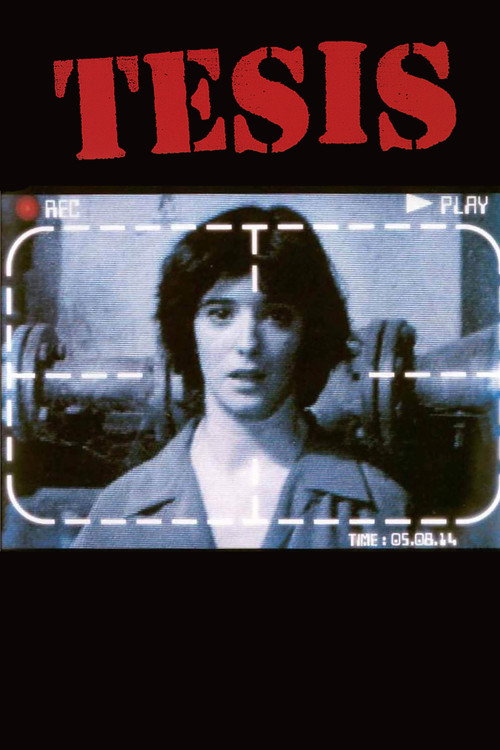
Thesis
Spanish (Tesis)
1996 · Directed by Alejandro Amenábar · 125 min


Horror · Thriller
Spanish (Tesis)
1996 · Directed by Alejandro Amenábar · 125 min
Meaning, unpacked
Central idea
Tesis can be read as a film about the viewer's complicity. It makes the audience share Ángela's fascination with violent images, then asks what that fascination feeds, and who profits from it.
What it means
Tesis begins as a story about a student studying violence on screen, and turns into a story about a student who cannot look away. Ángela, a young researcher, follows a trail through her university's video archive and into the world of the snuff film.
The central idea is the viewer's complicity. The film makes you share her fascination, then asks what that fascination feeds, and who profits from it. Her academic distance gives way to real attraction and real fear. Watching is never neutral here: recording, projecting and surveillance all carry power, and the film keeps asking who is holding the camera. Even the university, a place of detached study, is tangled up in what it analyses, and charm and authority prove poor guides to character. In the final confrontation, Ángela stops being an observer and becomes part of the image.
Why it mattered
Alejandro Amenábar wrote and directed Tesis while still a young film student, and he composed the music too. His direction recalls Hitchcock: he withholds, delays and redirects your attention, so suspense comes from what you are made to wonder about, not only from what you see. Sound often does the work of images, and the film uses real university spaces, lit by turns as clinical and Gothic, so an ordinary setting carries an undercurrent of horror.
In the 1990s, Spanish mainstream cinema had few thrillers or horror films. Tesis, alongside the work of Álex de la Iglesia, helped show that homegrown genre films could draw crowds and win respect. In Spain it was a major success, winning seven Goya awards, including Best Film and Best New Director.
Before anyone tells you what to think: what did you make of it?
Log in to rate it and leave commentsIt takes one click with Google or an email link. You come straight back here.
Rate it, keep your notes, and find the next film.
Free, no ads. Your journal, your lists, a Cine Guide that remembers you.
Create your free spaceTesis launched Amenábar's international career, leading to Open Your Eyes, again with Eduardo Noriega, and then The Others. It also helped open the way for the later wave of Spanish horror and thrillers that found audiences worldwide. Noriega became one of the country's leading young actors, and Fele Martínez got a prominent early role.
Today the film looks ahead of its time. Recorded violence and online spectatorship have only become more pressing since the internet, and it is often taught in discussions of screen violence and the ethics of watching. One note on myth: snuff films are largely an urban legend, with no verified market for real killings on film. Tesis plays on that fear rather than reporting a known practice.
What happens
Cornered, Ángela fights for her life against a killer who wants to film her death. She survives and exposes the truth, which shows the danger was inside her own university all along.
The last image
The film closes on a sense that the images still circulate and the appetite for them has not gone away.
What it says
Ángela begins as an observer and ends up inside the image. Her escape settles the plot but not the question, because the film implicates us too: our curiosity about violence is part of what keeps such images alive.
Or follow an idea from this film

Follow the idea
Peeping Tom (1960)
The classic film about the camera as an instrument of violence. It shows where Tesis found its questions about watching and filming.
Continue the director
The Others (2001)
Amenábar's next major success shows how his control of suspense developed, now in a classic haunted-house form.

Compare another approach
Funny Games (1997)
Another 1990s thriller that implicates its audience in screen violence. Compare Haneke's hostile approach with Amenábar's more traditionally suspenseful one.

See what influenced it
Blow Out (1981)
De Palma's thriller about recorded evidence and a hidden crime, an earlier treatment of media as clue and trap.
Explore the era or movement
The Spirit of the Beehive (1973)
Ana Torrent's first great role, in a very different Spanish film. It shows the art-cinema tradition she brought with her to Tesis.