Documentary
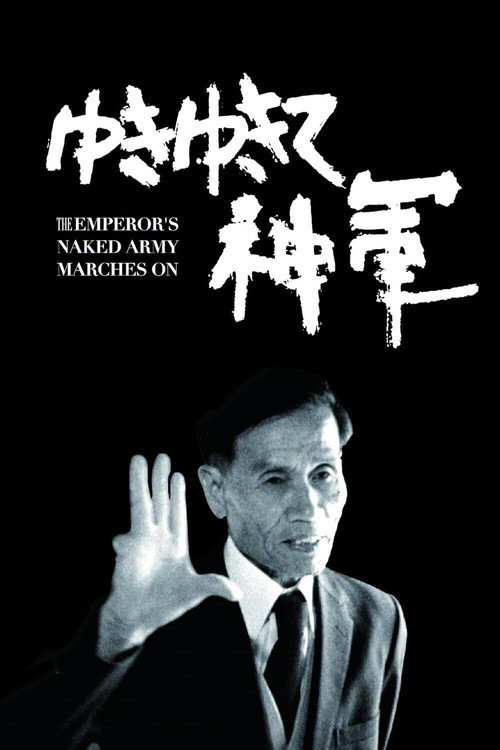
The Emperor's Naked Army Marches On
Japanese (ゆきゆきて、神軍)
1987 · Directed by Kazuo Hara · 122 min


Documentary
Japanese (ゆきゆきて、神軍)
1987 · Directed by Kazuo Hara · 122 min
Meaning, unpacked
Central idea
The film can be read as an inquiry into how a nation avoids its wartime past and what happens when one man refuses to let it. It also questions whether a righteous pursuit of truth can justify violence.
What it means
Kenzo Okuzaki, a veteran with a black van and a loudspeaker, hunts down the men of his old unit to learn what happened in New Guinea. The film asks how a nation avoids its wartime past, and what happens when one man refuses to let it. Veterans and families have lived for decades with partial stories, kept partial by silence, politeness and rank. The men speak in careful, deferential tones until someone leans on them. As the search climbs the chain of command, the film also asks who really answers for an order.
Its harder question is whether a righteous pursuit of truth can justify violence. Okuzaki demands honesty, but uses intimidation and force to get it, so you may want him to succeed and still flinch at how he does it. He is also a performer, with slogans, speeches and rehearsed gestures, and you are left wondering how much is conviction and how much is theatre. The truth about New Guinea comes in fragments, with veterans describing the killing of their own comrades and the hunger and desperation behind it. A staged reconstruction blurs reality and re-enactment, asking whether an invented scene can reach what interviews cannot.
Why it mattered
Kazuo Hara had made intimate, confrontational documentaries in the 1970s, and he saw in Okuzaki a subject who would do on camera what a conventional crew could never provoke. The film is built on that partnership. It rejects the idea that a documentary simply records what would have happened anyway: Okuzaki stages confrontations, and the crew's presence shapes events. Hara and his crew do not stay invisible, and the film keeps that in view.
Before anyone tells you what to think: what did you make of it?
Log in to rate it and leave commentsIt takes one click with Google or an email link. You come straight back here.
Rate it, keep your notes, and find the next film.
Free, no ads. Your journal, your lists, a Cine Guide that remembers you.
Create your free spaceIt also looks and sounds unlike most documentaries. The handheld camera follows Okuzaki into doorways, cars and rooms, creating intimacy and a sense of intrusion. There is no score to tell you what to feel, only silence, car noise, loudspeakers and arguments. The structure works like a detective story, each witness opening another door. And it arrived while Emperor Hirohito's wartime responsibility was still a sensitive subject in Japan, with a protagonist who openly blamed the emperor.
The film became a touchstone for documentaries in which the filmmaker provokes or collaborates with the subject, and for later films that confront perpetrators and the culture of silence around atrocity. It is used in courses on Japanese cinema, war memory and documentary ethics, and the veterans' accounts of New Guinea are the part most often discussed. If you want to go further, look for those films.
At the time it provoked strong reactions in Japan and abroad. Many critics praised its audacity, while others questioned the ethics of filming a man who turned violent. Okuzaki was later imprisoned for a shooting linked to his campaign, and he died in 2005. Today it is regarded as one of the great Japanese documentaries and a central work on the ethics of non-fiction filmmaking, seen as a study of memory and complicity, not just a portrait of an eccentric. It leaves you with an uncomfortable share of the responsibility: you watched, and the camera kept rolling for you.
What happens
Okuzaki traces the killing of the two soldiers up the chain of command to an officer's family. You learn they were executed after the war ended, amid famine and cannibalism, and the survivors still shield whoever gave the order.
The last image
A caption tells you Okuzaki was later imprisoned after a shooting, so the film ends on his violence, not on any answer.
Two readings
What it says
The ending refuses a neat verdict because the film is about silence and obedience, and about whether righteous anger can justify force. The camera that kept rolling leaves you to weigh it yourself.
Or follow an idea from this film

See its influence
The Act of Killing (2012)
Joshua Oppenheimer's film also puts perpetrators of atrocity in front of the camera and asks how memory and performance relate to guilt.
Compare another approach
Shoah (1985)
Another documentary built on testimony about wartime atrocity and on pressing witnesses to speak, though Lanzmann's method is slow and formal where Hara's is volatile.

See what influenced it
Salesman (1969)
The Maysles brothers' observational classic shows the direct cinema tradition that Hara both draws on and breaks away from.
Follow the idea
Harakiri (1962)
A Japanese drama in which an individual challenges a rigid, hypocritical code of authority and honour, a theme that recurs in Okuzaki's campaign.