Drama · War
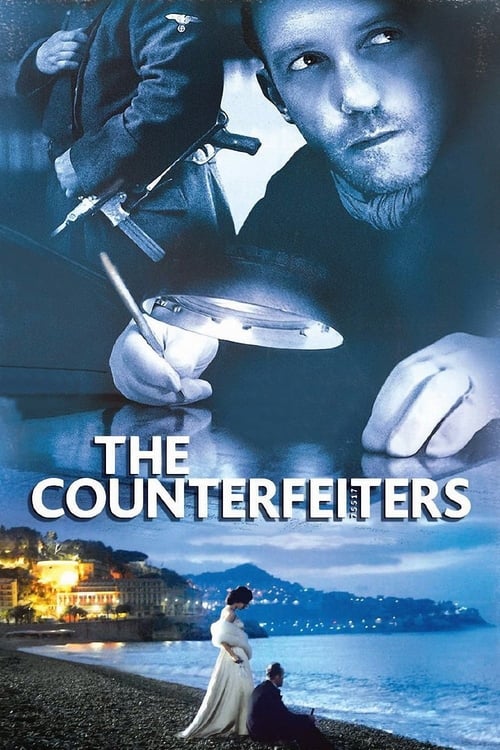
The Counterfeiters
Austrian (Die Fälscher)
2007 · Directed by Stefan Ruzowitzky · 98 min


Drama · War
Austrian (Die Fälscher)
2007 · Directed by Stefan Ruzowitzky · 98 min

Meaning, unpacked
Central idea
The film explores survival under coercion: what you owe yourself and others when staying alive means serving your persecutors. It can be read as a debate between pragmatism and principle, with neither side fully vindicated.
What it means
At its heart, The Counterfeiters argues that staying alive is not the same as being free. Sally, a forger, is kept alive in a camp workshop because his skill is useful to the regime. He and his fellow prisoners make fake currency for it. The film asks what you owe yourself, and what you owe others, when survival means serving the people who persecute you.
It answers with a debate between pragmatism and principle, and lets both sides stand. Sally survives by being useful, though his compassion is real too, as the scene around a sick young prisoner, Kolya, shows. Burger would rather slow the work down, and his sabotage turns the film into a thriller, because resistance endangers everyone in the room. The film also plays with truth and falsity: forged money and staged normality echo a regime built on lies. It opens in the aftermath and ends in a casino, where survival brings no relief.
Why it mattered
When it premiered in competition at the Berlin Film Festival in 2007, it offered something different from the Holocaust dramas that came before. Most camp stories ask who resists and who dies. This one asks what survival requires when your skills are useful to your captors, and it refuses easy answers. It widened the Holocaust film from the death-camp image to a story of coerced complicity.
The style was new too. Handheld shots and close framing keep you inside the group's tension, intimate rather than epic, resisting the monumental look of earlier films. Director Stefan Ruzowitzky, known for thrillers, used a ticking clock and a team under pressure to carry a hard subject to a wide audience without turning it into spectacle. Critics praised the performances, especially Karl Markovics, and the refusal to make a simple hero of its lead.
Before anyone tells you what to think: what did you make of it?
Log in to rate it and leave commentsIt takes one click with Google or an email link. You come straight back here.
Rate it, keep your notes, and find the next film.
Free, no ads. Your journal, your lists, a Cine Guide that remembers you.
Create your free spaceThe film helped make stories of moral compromise in the camps more familiar, a space later explored more radically in Son of Saul. It also showed that a thriller structure could carry difficult history. It brought attention to Adolf Burger's testimony and to Operation Bernhard, the Nazi scheme to forge British and American currency, far less known than other camp histories. At the 2008 Academy Awards it won Best Foreign Language Film, a first for Austria.
Today it is often taught and discussed for its treatment of complicity and survival. Its dilemma, whether to help the regime in order to live or to sabotage it and die, echoes Primo Levi's idea of the camps' grey zone. Some critics found its thriller structure conventional, but most admired its moral complexity, and its reputation has stayed steady.
What happens
The prisoners survive until liberation. In Monte Carlo, Sally gambles away the forged money he kept, then walks the beach with Burger, who has lost his wife. Winning and losing mean nothing to him; being alive has not made him free.
The last image
Sally and Burger stand together on the beach in Monte Carlo, two survivors with nothing left to say.
What it says
The ending refuses a triumphant release. Sally's survival was bought by being useful, and the film shows that it brings no relief and no clear verdict on him or Burger. You are left asking what you would have done.
Or follow an idea from this film

Compare another approach
Son of Saul (2015)
Also about a prisoner whose forced work serves the camp. It strips away the thriller structure for a stark, immersive form, so it makes a revealing comparison.
See what influenced it
Schindler's List (1993)
The landmark Holocaust drama in which a prisoner's usefulness brings protection. Compare its moral clarity with this film's ambiguity.
Explore the era or movement
The Lives of Others (2006)
Another German-language film from the same period that examines complicity and conscience under a surveillance regime, with a similar mix of thriller and moral drama.
Follow the idea
Night and Fog (1956)
The short documentary that shaped how cinema looks at the camps. It gives the historical reality behind the setting.
Jump forward
The Zone of Interest (2023)
A recent, formally daring approach to Nazi atrocity that shows how far the genre has moved from conventional drama.