Documentary
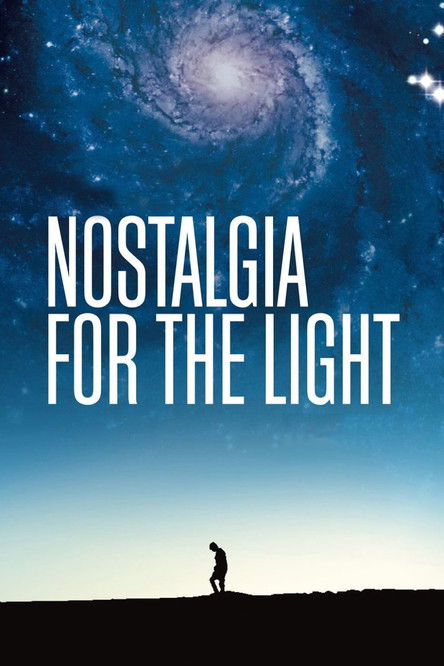
Nostalgia for the Light
Chilean (Nostalgia de la luz)
2010 · Directed by Patricio Guzmán · 93 min


Documentary
Chilean (Nostalgia de la luz)
2010 · Directed by Patricio Guzmán · 93 min


Meaning, unpacked
Central idea
The film can be read as an argument that the past is never gone: light from distant stars, ancient remains and the missing of a dictatorship all reach us from earlier times. Remembering is shown as a form of seeking, and as a duty.
What it means
Nostalgia for the Light moves between two kinds of searching. Astronomers scan the sky above the Atacama Desert, while women scan the ground below it, looking for the remains of relatives who were disappeared under the dictatorship. Patricio Guzmán, narrating softly, joins the two.
The central idea is that the past is never gone. Light from a distant star left its source long ago, and we only see it now. Ancient remains lie in the dry earth, and the missing of a dictatorship also reach us from an earlier time. Here, remembering is a form of seeking, and it is also a duty. The film asks whether the work of the scientists and the work of the searching women come from the same human impulse. Its other themes grow from there: memory against forgetting, the desert as a kind of archive, and Guzmán's own longing for a country he had to leave.
Why it mattered
Guzmán builds the film by association, not by argument. It drifts between astronomy, archaeology, mining history and political memory, and images and echoes make the links. Wide desert vistas and night skies sit beside close shots of sand, stone and dust, so large and small scales answer each other. The argument forms slowly, and you may only feel it complete itself near the end.
The film also trusts the desert and the people in it. The Atacama's dryness preserves mummies, rock carvings and bones, so the landscape works as a memory. The score is restrained, with long stretches of near silence. The women searching are not actors. They are relatives of the disappeared who have searched for decades, and Guzmán films their work as it is, with no staged drama. Their patience gives the cosmic scale a human cost.
Before anyone tells you what to think: what did you make of it?
Log in to rate it and leave commentsIt takes one click with Google or an email link. You come straight back here.
Rate it, keep your notes, and find the next film.
Free, no ads. Your journal, your lists, a Cine Guide that remembers you.
Create your free spaceCritics greeted the film as one of the most poetic and moving documentaries of its year. It won the European Film Award for best documentary and travelled widely at festivals, bringing Guzmán a new international audience. It helped confirm a model of documentary in which landscape and image carry historical argument, and it encouraged later filmmakers to approach political trauma through poetic, meditative forms.
Its reputation has grown with the years. It is now seen as a high point of essayistic documentary and is often taught as an example of using metaphor without losing a factual grounding. Its image of women sifting the desert became an emblem of Chile's unresolved reckoning with the dictatorship, and of the wider Latin American search for the disappeared. It also helped make the Atacama a symbol of both astronomy and memory. Guzmán carried these themes on in The Pearl Button and The Cordillera of Dreams.
What happens
The film ends by joining its two searches. The telescopes can read the distant past in the sky, but they cannot look down at the desert floor, where the disappeared still lie. The film wishes they could.
The last image
The film closes on the Atacama's night sky above the ground where the women keep searching.
What it says
The ending asks you to treat remembering as a duty, not a mood. Starlight and buried bones both arrive from the past, and both can be recovered. The film ends with hope because the search, however slow, is still going on.
Or follow an idea from this film

Continue the director
The Battle of Chile: Part I (1975)
Guzmán's great earlier documentary, a direct record of the political crisis whose consequences Nostalgia for the Light reflects on decades later.

Compare another approach
Night and Fog (1956)
Another short, poetic film about how landscape holds the memory of atrocity, and how a place can be both ordinary and haunted.

Explore the era or movement
The Official Story (1985)
An Argentine drama about the aftermath of a military dictatorship and the disappeared, which shows how Latin American cinema approached the same wound.

Follow the idea
The Tree of Life (2011)
Terrence Malick also links the cosmos with personal grief and memory, though through fiction and a very different tone.
Compare another approach
Lessons of Darkness (1992)
Werner Herzog's poetic documentary uses landscape and spare narration to look at devastation in a similarly meditative way.