



Drama · Comedy · Romance
The Rules of the Game
Avg rating 8.8 / My rating TBC
1939 · Directed by Jean Renoir · With Jean Renoir, Marcel Dalio, Nora Gregor
- Poetic Realism
- Art Cinema
- Comedy
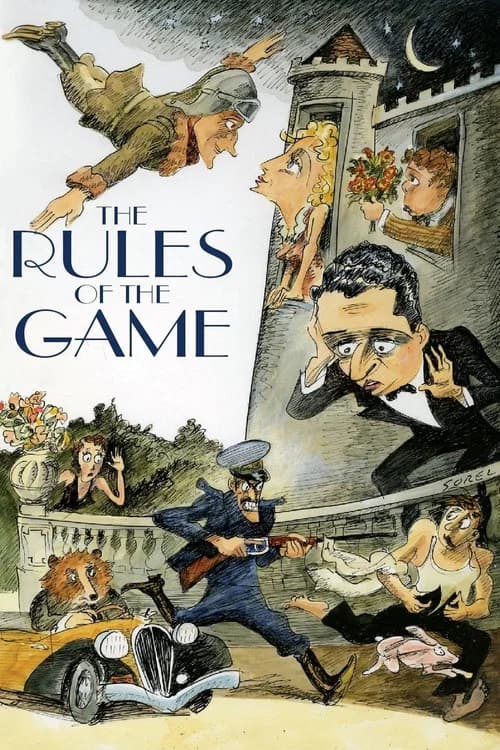
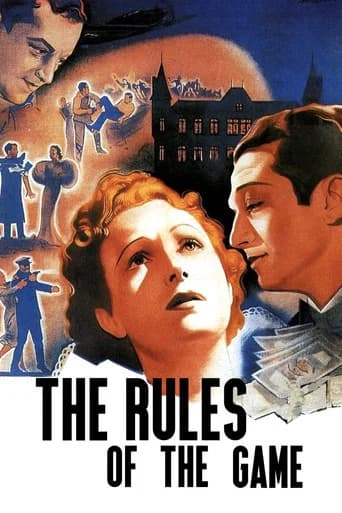
An aviator's public declaration of love for a married woman sends ripples through Parisian high society. A marquis invites his friends to a country estate for a weekend of hunting and a masked entertainment, while his servants carry on their own affairs below stairs. A comedy of manners with a sharp eye.
Film info
- Runtime
- 1h 50m · 110 min
- Format
- Black and white, roughly 1.37:1, sound.
- IMDb
- 7.9 / 10 (31,917 votes)
- Rotten Tomatoes
- 97% (critics)
- Metacritic
- 99 / 100
- TMDB
- 7.5 / 10 (audience, 684 votes)
- Trailer
- ▶ Watch the trailer





Before watching
Spoiler-free · about 2 minutes
Why watch this?
Renoir's most celebrated film and a pillar of French cinema
Alongside La Grande Illusion, this is Jean Renoir's best-known work, and the most admired French film of the 1930s. Later filmmakers, including the New Wave directors, treated it as a founding text.
A comedy where every character is taken seriously
Farce, romance and social observation run side by side, and masters and servants are given equal sympathy and equal scrutiny. Almost no one in the film is simply a hero or a villain.
A masterclass in staging many people at once
Renoir keeps the camera moving through crowded rooms, using depth and long takes so that several storylines unfold in a single shot. It is a model for the ensemble film.
Why it matters in cinema history
A defining film of late-1930s French cinema and the template for the ensemble social comedy, it moved film language toward depth, long takes and a more fluid, observational style.
Watch with intention
Your lens
Watch it as a comedy of manners in which the camera, not just the dialogue, shows who belongs where.
Three things to notice
- How often the camera holds a long shot with action at several depths, so that servants and guests are visible in the same frame.
- How the servants' world mirrors the guests' world, in their flirtations, jealousies and etiquette.
- How tone shifts within single scenes, with comic business and sincere feeling sitting side by side.
One question to carry with you
The characters keep invoking an unwritten code of behaviour. Who actually benefits from it, and who is simply trapped by it?
- Technology
- Sound was by now fully mastered. Renoir used it to layer overlapping conversations and let the camera roam, instead of cutting between speakers as most studio films did.
- Dominant styles
- French Poetic Realism favoured studio-built working-class settings and doomed lone heroes. Renoir moved the action to an aristocratic country house and spread attention across a whole ensemble.
- Industry
- Renoir had just made La Grande Illusion (1937), a major international success, and La Bête humaine (1938). He made this film with his own production company and a freedom few directors had.
- Audience
- The film opened in Paris in July 1939, weeks before war began. Audiences were anxious and in no mood to see their own society reflected back at them.
Where it came from
Film
La Grande Illusion (1937)
Renoir's earlier study of class and loyalty across social lines, which established his humane, observational approach.
Tradition
Comedy of manners and Musset's theatre
The tradition of romantic comedy with real emotion underneath, in which Renoir found the model for his tangled house party.
Movement
Poetic Realism
The French mood of the decade, with its atmospheric realism and social observation, which Renoir both belonged to and widened.
This film
The Rules of the Game (1939)
New at the timeIt treated a whole social class, upstairs and downstairs, as one ensemble, and mixed farce, social satire and gentle observation in a single, fluid style.
- Country and moment
- France in 1938–39 was politically polarised after the Popular Front's collapse and shaken by the Munich Agreement. Many feared another war with Germany, and anxiety and cynicism ran through public life.
- Society and audience
- The film portrays an aristocratic and servant-class world that Renoir saw as complacent and out of touch. It premiered in July 1939, and many viewers took it as an insult to French society and to themselves.
- Politics and censorship
- After the outbreak of war in September 1939, the government banned the film as demoralising. Under the Occupation it stayed banned, and the original negative was damaged in Allied bombing.
- The filmmaker's situation
- Renoir was then one of France's most prominent directors, with a left-leaning record from La Grande Illusion. He set up his own production company to make this personal film. Its failure, and heavy cuts to the original, marked a low point before he left for the US.
- Pace
- Unhurried at first, then increasingly busy. The long middle section at the country house is dense with overlapping characters and incidents.
- Style
- Fluid camerawork, deep staging and long takes. Dialogue often overlaps, and comedy and feeling share the same scenes.
- Format
- Black and white, roughly 1.37:1, sound.
- Language
- French with subtitles. Wit and class distinctions live in the dialogue, so it is worth reading closely.
- Versions
- The 1939 release was cut heavily after a poor reception. The version now shown is a restoration assembled in the late 1950s, running about 110 minutes.
12+
Suggested age
Teens
Official ratings are lenient (France U, Britain PG, US unrated; lowest implies 8), but adult infidelity themes, subtitles and a talky black-and-white style suit ages 12 and up.
Official ratings
- USNR
- UKPG
- FranceU
Good for
Teens curious about classic cinema may enjoy the sharp social comedy, the lavish country-house setting, a lively hunting-party sequence and playful farce, plus its famously fluid camerawork.
May unsettle
- Mature themes: Adultery, flirtation and romantic deceit run through the story, treated as comedy and as heartbreak, with no explicit content.
- Violence: Some chases and gunplay, including a hunt, and a darker turn late in the film. Not graphic, but the mood shifts.
- Pace: Black-and-white, subtitled, dialogue-heavy with a large cast. Younger children may struggle to follow who is who.
- Dated attitudes: Class snobbery and some period attitudes to gender and to outsiders are part of the satire and may need comment.
Explain first
- It is a French satire from 1939 poking fun at the rich and their servants, made just before the Second World War.
- It is in French with subtitles, so reading speed matters. A quick guide to the main characters helps.
Talk about it after
The film suggests the rich and their servants follow different 'rules'. Where did you see those rules at work, and who did they protect?
Cinespective's own guidance, a draft: check it against the official ratings and your own judgement. Second opinions: Common Sense Media, IMDb (see its Parents Guide). Ratings from TMDB.