


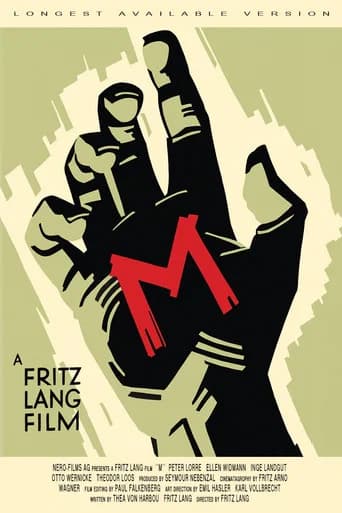

Drama · Thriller · Crime
M
Avg rating 8.8 / My rating TBC
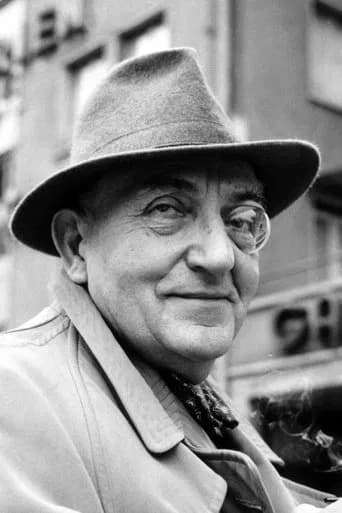
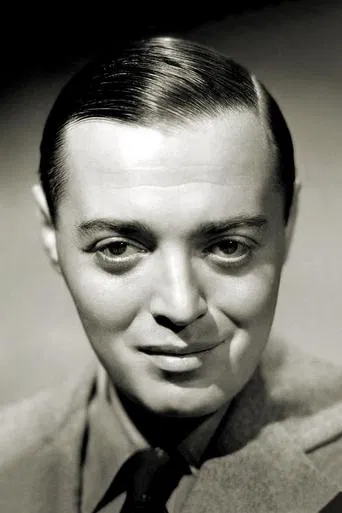
1931 · Directed by Fritz Lang · With Peter Lorre, Ellen Widmann, Inge Landgut
- Early Sound
- Suspense
- German Expressionism
- Art Cinema
A Berlin gripped by fear as a string of child murders goes unsolved. Fritz Lang's first sound film follows a city under pressure, with a sprawling cast and a cool, procedural eye rather than a single hero.
Film info
- Runtime
- 1h 50m · 110 min
- IMDb
- 8.3 / 10 (179,355 votes)
- Rotten Tomatoes
- 100% (critics)
- TMDB
- 8.1 / 10 (audience, 2,552 votes)
- Trailer
- ▶ Watch the trailer



Before watching
Spoiler-free · about 2 minutes
Short on time? Spoiler-free
A 3-minute summary
Why watch this?
Fritz Lang's first sound film, and a landmark of early sound
Lang's debut in sound and one of the defining German films of 1931. It shows how a director used silence, offscreen noise and overlapping speech to shape suspense when talkies were still new.
The film that made Peter Lorre an international name
Lorre was known mainly on the Berlin stage. This role gave him a screen presence that is unlike the usual villain of the period and carried him into a career abroad.
Suspense built from sound, editing and a whole city
The film earns its tension through sound design, precise cutting and a point of view that spans many characters and places, not one hero. It is a template for the modern crime thriller.
Why it matters in cinema history
A pivotal work of the transition from silent to sound cinema and of late Weimar filmmaking. It links Expressionist visual style to the realism and procedural detail that later crime films adopted.
Watch with intention
Your lens
Watch it as a study of how sound and editing can make ordinary rooms and streets feel tense.
Three things to notice
- How often the soundtrack carries information the image withholds: voices off screen, sudden silence, a repeated sound that returns in different contexts.
- Compositions built from shadows, doorways, windows and reflections, which turn everyday spaces into places of pressure.
- How Lang links separate scenes by overlapping a line of dialogue or a gesture from one room into the next.
One question to carry with you
How does a film make a whole city, rather than one hero, its main character?
- Technology
- Sound had arrived in Germany only a few years earlier. Cameras were bulky and many early talkies were static and stage-bound, so mobile, expressive sound was still unusual.
- Industry
- Berlin's studios were among the strongest in Europe, with skilled designers and cinematographers. The film was made independently of the biggest studio, Ufa, by Nero-Film.
- Dominant styles
- Expressionist shadows and angles were giving way to the sober, observational mood of New Objectivity. The film draws on both.
- Director's moment
- Lang had made large silent spectacles such as Metropolis. Here he works on a smaller canvas, with a contemporary setting and dialogue.
Where it came from
Film
Dr. Mabuse the Gambler (1922)
Lang's earlier crime epic of a corrupt city and a network of criminals, which M reworks in a smaller, more realistic and more ambiguous form.
Movement
German Expressionism
The dramatic shadows, tilted spaces and psychological use of design in M descend from the Expressionist silent films.
Movement
New Objectivity
The sober, documentary-like attention to city life and social problems in late Weimar art and film shapes the film's realism.
This film
M (1931)
New at the timeAn early sound thriller that treats sound as a storytelling tool, through silence, offscreen noise and recurring audio motifs, and tells its crime story across an entire city.
- Country and moment
- Shot in 1930–31, after the 1929 crash hit Germany hard. Millions were jobless, governments ruled by emergency decree, and street fighting between Nazis and Communists was routine in Berlin.
- Society and audience
- Berlin was a huge, anxious metropolis with widespread poverty and fear of crime. Press coverage of notorious serial killers, such as Peter Kürten in Düsseldorf (arrested 1930), had made public panic over such cases very real.
- Politics and censorship
- Weimar film still faced a censorship board, and conservative and Nazi groups attacked films they saw as immoral. The Nazis took power in 1933, and this film was later banned, with a reworked version appearing in their era.
- The filmmaker's situation
- Lang was Germany's most celebrated director, working with producer Seymour Nebenzahl's independent company. He and co-writer Thea von Harbou later parted ways. Lang left Germany in 1933 after Goebbels's regime courted him.
- Pace
- Deliberate and procedural at first, with long dialogue scenes and many characters. Tension builds through accumulation rather than action.
- Sound
- Early talkie with very little scored music. Silence, ambient noise and offscreen sound do much of the work.
- Colour / aspect
- Black and white in a near-square frame, with strong contrasts of light and shadow.
- Language
- German with subtitles. Dialogue is brisk and Berlin-flavoured, so subtitles matter.
- Versions
- Surviving prints vary in length and quality. A modern restoration is the best way to see it.
- Performance
- Theatrical but controlled. Many small parts are drawn with a distinct physical type.
12+
Suggested age
Teens
Ratings range from PG (GB) and all audiences (FR) to 12 (DE). Twelve fits the disturbing central subject, plus the subtitles, long running time and talky pace.
Official ratings
- UKPG
- Germany12
- FranceTP
Good for
Older children and teens curious about classic cinema may enjoy the tense atmosphere, inventive early sound design, sharp black-and-white visuals and a gripping, morally complicated story that rewards discussion.
May unsettle
- Mature themes: The story centres on harm to children. Nothing is shown graphically, but the subject is distressing and may weigh on younger or sensitive viewers.
- Intensity: Sustained dread, paranoia and a growing atmosphere of fear and suspicion run through much of the film, building to some very tense sequences.
- Pace: At nearly two hours, with long dialogue-driven scenes of investigation and debate, it can test the patience of children used to modern films.
- Dated attitudes: Some views on crime, punishment and mental illness reflect 1930s Germany and are presented in ways that may feel old-fashioned or unsettling.
Explain first
- It is an early sound film from 1931: black and white, in German, so you will need subtitles and some patience with its older style.
- The story deals with a threat to children in a city. Consider telling them beforehand that it is serious and dark, not an action adventure.
- Made in Germany between the wars, it reflects a society under strain, with fear, distrust and debates about how justice should work.
Talk about it after
The film asks who has the right to judge and punish someone. What do you think makes a fair trial, and why does it matter?
Cinespective's own guidance, a draft: check it against the official ratings and your own judgement. Second opinions: Common Sense Media, IMDb (see its Parents Guide). Ratings from TMDB.