

Documentary
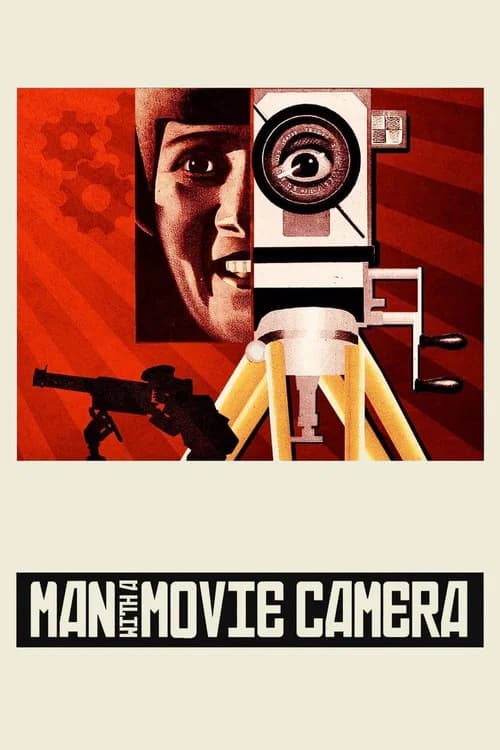
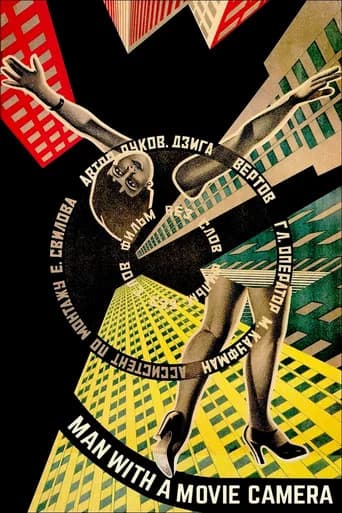
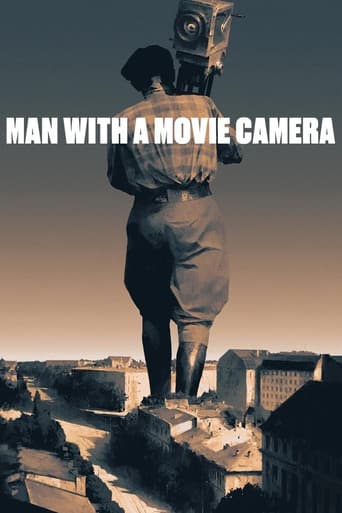
Man with a Movie Camera
Avg rating 8.9 / My rating TBC
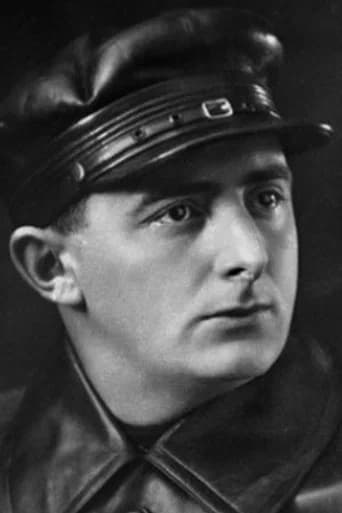
1929 · Directed by Dziga Vertov · With Mikhail Kaufman
- Silent Cinema
- Soviet Montage
- Art Cinema
A cameraman and his camera travel through a single day of city life, from waking streets to factories, beaches and theatres. There is no story and no actors in the usual sense: the film is an argument about what cinema can do, made out of everyday reality.
Film info
- Runtime
- 1h 08m · 68 min
- Format
- Experimental non-fiction with no plot, no characters and no intertitles in the usual sense. It is built like a piece of music.
- IMDb
- 8.3 / 10 (30,786 votes)
- Rotten Tomatoes
- 98% (critics)
- Metacritic
- 96 / 100
- TMDB
- 7.8 / 10 (audience, 833 votes)
- Trailer
- ▶ Watch the trailer
Full cast and crew
Before watching
Spoiler-free · about 2 minutes
Why watch this?
The most radical experiment of Soviet montage
Dziga Vertov's best-known work pushes the montage movement to its limit, using superimpositions, split screens, freeze frames and rapid cutting to treat film as a language of its own, free of theatre and literature.
A film about filmmaking itself
Cameras, editing tables and audiences appear on screen throughout. It is among the earliest and boldest films to show its own making, which makes it a lasting reference for self-aware cinema.
A city symphony with no script
Footage from several Soviet cities is woven into one imagined day. It reads as both documentary and visual poetry, and it still feels fresh in its energy and invention.
Why it matters in cinema history
A defining film of the 1920s avant-garde and of the city symphony form, it set out a vision of non-fiction cinema as formal experiment that documentarians and video artists still return to.
Watch with intention
Your lens
Watch it as a demonstration of what only cinema can do, not as a documentary about a place.
Three things to notice
- How often the film reveals its own making: the cameraman with his tripod, the editor at her table, the audience in the theatre.
- The rhythm of the cutting: when it speeds up, when it slows or freezes, and how movements in one shot answer movements in the next.
- The visual tricks: double exposure, split screens and unusual angles, and what each makes you notice about ordinary things.
One question to carry with you
If a film has no story and no characters to follow, what holds your attention, and what is it asking you to see differently?
- Soviet context
- After the 1917 revolution, the state backed film as a tool for educating and mobilising a huge, partly illiterate population. Montage was treated as both an art and a political method.
- Vertov's position
- Vertov led the Kino-Eye group, which rejected staged drama as bourgeois and wanted the camera to record life as it is, then reorganise it by editing. He also ran an ongoing quarrel with Eisenstein's fiction films.
- City symphonies
- Films such as Berlin: Symphony of a Great City (1927) used a day in a city as a structure. Vertov's film shares the form but is far more radical in technique.
- Technology
- Silent film was at its technical peak, just before sound took over. Lightweight cameras and fast stock allowed filming in the street, in motion and from unusual angles.
Where it came from
Movement
Soviet Montage
Eisenstein, Kuleshov and Pudovkin treated editing as the core of film art. Vertov shared the premise but applied it to non-fiction.
Film
Berlin: Symphony of a Great City (1927)
Walter Ruttmann's film established the city symphony as a form, organising a day in a city by rhythm. Vertov's film is a more radical version.
Filmmaker
Kino-Eye
Vertov's own theory and newsreel series, which called for the camera to record unstaged life and use editing to reveal its meaning.
This film
Man with a Movie Camera (1929)
New at the timeIt showed the full machinery of cinema (camera, editor, projector, audience) as part of the subject, and used trick effects on real footage as a form of argument.
- Pace
- Very fast and dense. Shots are often only a second or two long, so the film rewards attention more than patience.
- Format
- Experimental non-fiction with no plot, no characters and no intertitles in the usual sense. It is built like a piece of music.
- Sound
- Silent. Scores vary by release; the best-known modern accompaniments are by the Alloy Orchestra and the Cinematic Orchestra.
- Colour and ratio
- Black and white, in the standard silent-era 1.33:1 frame.
- Language
- Almost no text. A title card at the start states the film's aim, and no knowledge of Russian is needed.